
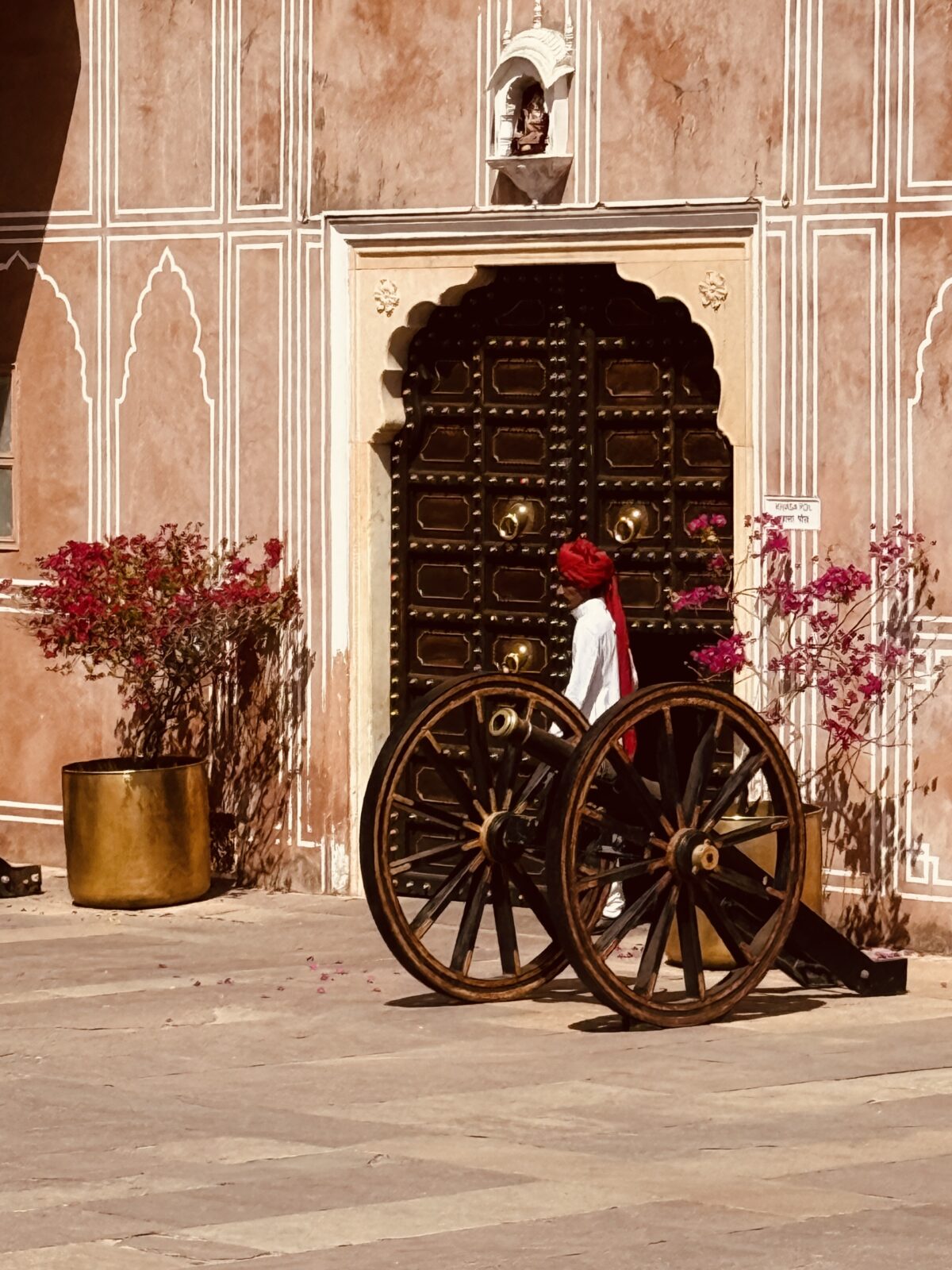
As we left the colors and chaos of Holi behind, we turned toward India’s “Golden Triangle”—the historic corridor linking Delhi, Agra, and Jaipur. Each city felt like a different chapter of the same story: Delhi layered with centuries of empires and modern energy, Agra anchored by the breathtaking symmetry of the Taj Mahal, and Jaipur glowing in shades of pink sandstone and royal heritage. Together, they form a journey through the architecture, ambition, and artistry that shaped northern India—and a reminder that in this country, history is never really in the past; it’s still very much alive in the streets you walk through today.
Uniworld: India’s Golden Triangle and the Sacred Ganges
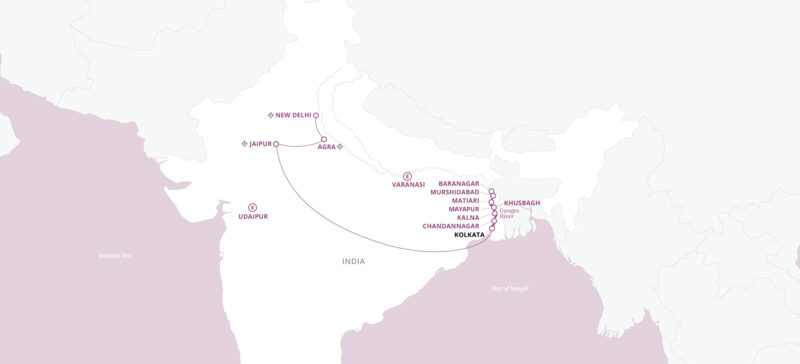
The nidus for our trip to India was Uniworld’s India’s Golden Triangle and Sacred Ganges cruise tour, which is a 13- day exploration of said areas. Uniworld’s website shows dates from September to March, and here is the itinerary:
Optional, Udaipur, India Pre-Cruise Extension
Day 1: New Delhi
Day 2: New Delhi
Day 3: New Delhi, Transfer to Agra
Day 4: Agra, Transfer to Jaipur
Day 5: Jaipur
Day 6: Jaipur, Fly to Kolkata (Embark), Cruising the Ganges River
Day 7: Kalna
Day 8: Matiari
Day 9: Murshidabad, Baranagar
Day 10: The Ganges, Khusbagh, Mayapur
Day 11: Mayapur, Chandannagar
Day 12: Kolkata
Day 13: Kolkata (Disembark)
Optional, Varanasi & New Delhi, India Post-Cruise Extension
Itinerary
Inclusions
Fares start around $8000 per person which, to be honest, is a great deal for everything you get. This includes 5 nights pre-cruise in 3 separate Oberoi properties, which are some of the most spectacular hotels in the world. India is known for it’s dedication to service in the tourism industry, and the Oberoi properties are shining examples of that. Read my thoughts on these properties here.
We stayed in the entry-level cabin onboard the ship, which was just lovely. We had a king-sized bed, a little table for two in front of a large window, a dresser and television (which we mostly used to play the soundtrack for our journey- Bollywood show tunes, of course!), a desk, a closet, and a large, hotel-sized bathroom with a fantastic shower. More storage would have been nice, but that is usually the case on cruise ships.
The price included everything except several meals on land, shopping of course, top-shelf alcohol and spa treatments:
- Meals onboard prepared using the finest and freshest ingredients
- 12 breakfasts, 9 lunches, 9 dinners
- Welcome and Farewell Gala Dinners
- Complimentary house wine, local spirits and beer, soft drinks, tea and coffee will be served during lunch and dinner onboard. Onshore lunches and dinners include complimentary soft drinks, coffee, and tea
- 10 days of excursions, all fully hosted by English-speaking local experts
- Transportation from the airport on arrival, between all sites, and back to the airport at the end
- Domestic airfare where applicable
Wow, the more I think about it, this REALLY was a great price! Contact me to book your Uniworld cruise today! And I’ll. hook you up with Tapas at Trinetra Tours 😉
This really was a great way to see some off-the-beaten track areas of India that not many people have the opportunity to experience. The Golden Triangle is the heart of the tourist circuit, but the Ganges… some of the people you encounter rarely see foreigners. This is a very special experience.
The pre- and post-cruise extensions look great as well, but we did not partake, as we had our own agenda. Do them if you’d like, or have Tapas take care of you.
India’s Golden Triangle: Delhi
Few cities overwhelm the senses quite like Delhi. India’s sprawling capital is a place where ancient history and modern chaos collide in the most fascinating ways — Mughal tombs rise beside glass office towers, the scent of incense mingles with street food and exhaust, and every alley seems to tell a story centuries in the making. At once exhausting and exhilarating, Delhi is more than just a gateway to India; it is a crash course in the country’s complexity, energy, and soul.
More Praise for Trinetra Tours
We arrived at the Delhi airport after our Holi experience in Khajuraho once again, and Parveen picked us up with a new driver. Now, I’ve been all over the world and had a lot of guides and hosts, many of whom I still keep in touch with. Only once have I visited a guide’s home, and that was in Bali when we just happened to be driving by. Tapas from Trinetra Tours invited us to his home for dinner!
Parveen, our Delhi handler we met upon arrival, took us to a flower market for a small token of appreciation, a lovely bouquet of red and blue flowers, sprinkled with gold dust and lovingly wrapped in tissue, then dropped us off at Tapas’s home in Delhi. When Tapas and I met, we embraced like old friends. We were welcomed so warmly by him, his wife Krishna, and his son Arjun. After over an hour of enthralling conversation, Krishna laid before us a magnificent spread of home cooked food, whose aromas permeated the house and made our mouths water! Chicken tiki masala, lentils, rice, homemade chicken sausage... and naan… oh the naan.
After all this hospitality and kindness, they gave us gifts! I was blown away.
We had such a lovely evening and lost track of time. We talked about everything, sharing our life stories, philosophies on travel, even political views and frustrations! It is rare when you can discuss politics without someone getting angry, but we did. This visit was a top travel experience and just reinforces the benefits of approaching travel, and life for that matter, with an open mind and heart. Just say YES!
Side note: Another example of the “next level” service provided by Trinetra. We always try to do laundry when we travel so we can pack lighter. Unfortunately, when we stay at nice places, doing a load of laundry can cost as much as a night in a hotel (it was something like 500-600 rupees/around $6 for ONE shirt at the Oberoi and Taj properties). It is usually pretty easy to do this on your own- most cities have laundry services on every corner. Typically, they charge by kilo and can have the laundry back to you the next day. It was a bit more challenging for us in Delhi, probably because the Oberoi was a bit out of the way in an upscale part of town near government offices.
I guess people who stay at hotels like this don’t worry about a few bucks… I’m sorry, but if I can have a near equivalent service for pennies on the dollar, why would I pay that much?
Parveen spent an inordinate amount of time and effort finding a laundry service for us, and even picked up our clothes and dropped them off. Now that’s service!
-

- With Tapas and Krishna

-
- With Arjun and Krishna


The Oberoi New Delhi
After dinner, Parveen and his driver picked us up and took us to the Oberoi New Delhi. It was late and we were exhausted, which the staff seemed to understand. We were greeted by an impossibly tall, mustachioed doorman who took our bags, put the rest of our belongings through the airport-style scanner, and entered the lobby.
A blast of cool air, gentle music, and light floral scents greeted us as I felt my heart rate immediately decrease. Hospitality staff greeted us with a brief welcome ceremony and an attendant took us immediately to our room to complete the check-in process. I thought this was a very nice touch after a long day of travel.
Our room for the next two nights was spacious, with a king-sized bed, seating area, desk, dresser with TV, and a massive bathroom. The large windows in the bedroom and bathroom had a view of the expansive city including the Tomb of Humayun.
The breakfast buffet here was fantastic, with more selections than we could ever try and good, strong coffee. We had a private group dinner here one night, which was surprisingly delicious- usually banquet type meals are not. The rooftop bar was elegant and cozy. I cannot speak to the other restaurants, as we prefer to get out and have our meals in the city.
Our Take on the City
Our time here was brief, but we got a whirlwind tour. Our city tour was arranged through Uniworld and included with our trip. There were around 50 people in our tour group, which required 3 large tour buses. I was immediately reminded why I HATE big bus tours… this is where you really feel like a tourist, not a traveler. Watching the city go by from a big window on high is not my idea of experiencing a culture. I sat on my air conditioned bus in my comfy seat, listening to a guide talk to me over a microphone, literally looking down on the people of the city.
An experience shared with one person/a few people becomes deeper; shared with too many, it risks becoming background noise.
We ticked boxes. I’m not a box ticker, but hey, look at the bright side, right? At least we got to see the major sites and get an overview of the city. No FOMO here! We will be back…
We stopped at Humayun’s Tomb for an hour or so. Humayun’s Tomb is one of Delhi’s most beautiful and historically significant monuments, often considered the architectural predecessor to the Taj Mahal. Built in the 16th century by the widow of Mughal emperor Humayun, the grand mausoleum blends Persian design with early Mughal architecture, featuring symmetrical gardens, red sandstone walls, and elegant white marble accents. Walking through its peaceful courtyards feels like stepping into the dawn of the Mughal Empire, where the artistic and architectural ideas that would later define India’s greatest monuments first began to take shape.
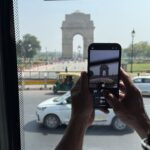
From a tour bus, India Gate rises first as a solemn war memorial framed by wide ceremonial boulevards, while nearby the grand avenues of Rajpath (now Kartavya Path) stretch toward the monumental seat of power at the Presidential Palace and surrounding government buildings of Lutyens’ Delhi. Farther on, the massive red sandstone walls of Red Fort dominate the Old City skyline, a powerful reminder of the Mughal Empire’s former glory. Together, these landmarks trace a sweeping arc through Delhi’s layered identity — colonial ambition, imperial history, and modern governance — all unfolding rapidly through the bus window in a blur of scale, symbolism, and constant motion.
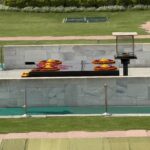
My favorite stop was Gandhi’s memorial. Raj Ghat, the memorial marking the cremation site of Mahatma Gandhi, is a place of striking simplicity and quiet reflection amid the chaos of Delhi. A black marble platform, inscribed with Gandhi’s final words, “Hey Ram,” which basically means “Oh Lord” speaking to Rama, rests within peaceful gardens where visitors gather to pay tribute to the man who led India’s nonviolent struggle for independence. Unlike the grandeur of many monuments in India, Raj Ghat’s understated design feels fitting for a leader remembered for humility, restraint, and moral conviction.
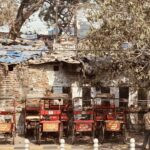
Finally, the big bus portion was over. We flooded out of its narrow doorway in Old Delhi for our cultural immersion. The polar opposite of a bug bus tour is a rickshaw tour! This was more like it… Favorite part of our tour.
This was a bicycle-powered rickshaw, not one of those fancy motorized tuk tuks with horns and doors… our driver worked! His legs were skinny but powerful, navigating the labyrinthine alleyways lined by innumerable shops selling everything from books to wedding saris.
Our senses were assaulted by vibrant colors, pungent smells, a cacophony of noise, oppressive heat, and occasional needy children. Chaos ruled the streets, as rickshaws fought tuk tuks, cars, and even huge trucks for position on the main roads. Occasional dogs and even cows obstructed traffic, ignoring the incessant beeping and honking. This was the good stuff!
We saw surprisingly few accidents, but had a couple of close calls- we locked horns with another rickshaw and almost got hit by a truck…
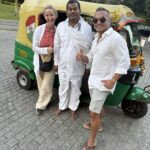
We had a little free time, so we hired a tuk tuk to take us to a barber shop so Vuong could get a haircut and shave. It is kinda his thing- wherever we go, he likes to experience this male equivalent of a spa treatment. A dude, usually one with a manicured beard, may be young and fashionable, may be old and experienced, cuts his hair, trims his eyebrows, lathers his face, and shaves him with a straight razor. The really fancy places will include a head and shoulders massage. This one cost less than $2!
-
- With our Doorman
-
- Humayun’s Tomb
-
- Rickshaw Parking
-
- India Gate
-
- Gandhi’s Memorial
-
- With our Tuk Tuk Driver
India’s Golden Triangle: Agra
There is far more to Agra than the iconic white marble silhouette that draws millions each year. Once the glittering capital of the Mughal Empire, Agra is a city layered with history, grandeur, and surprising contrasts. Beneath the shadow of the Taj Mahal lies a bustling city of crowded bazaars, chaotic streets, fading palaces, and rich culinary traditions. Here, reminders of imperial splendor stand beside the rhythm of everyday Indian life, creating a destination that feels both timeless and intensely alive.
The drive from Delhi to Agra took about 4 hours. Sure, we were comfortable on our fancy motor coach, but still felt removed from our surroundings. The scenery was stunning, similar to that I described on our earlier drive from Delhi to Abhaneri for Chand Baori. We stopped where most tourists likely stop, at a rest area about halfway to Agra. The rest stop had stalls for KFC and Burger King, and the menus were very interesting… Paneer sandwiches were the star, with masala-spiced chicken piquing our interest as well. Here’s where my developing travel philosophy came into play again- always say yes! We didn’t, and Vuong talked about it for the next 2 weeks! Eat the dang sammich!
The Oberoi Amarvilas
The Oberoi Amarvilas is the place to stay in Agra! It is very close to the Taj Mahal and only its guests can park this close. The entryway contained 4 symmetrical square pools with fountains, the lobby was grand with it’s crystal chandeliers, and the pool…
This pool was like nothing I’d ever seen. The main central cobalt blue pool was flanked by two grand tiered waterfalls flowing over stone terraces, which were in turn flanked by staircases. Above each of the waterfalls was a stone pavilion with loungers. The side opposite the main hotel is dominated by a pool house with al fresco dining tables, and the entire complex is surrounded by Mughal inspired gardens and manicured lawns, with the white marble of the Taj Mahal visible in the near distance.
Looking back to the hotel from the pool, you notice that part of the pool is actually indoors, underneath the main hotel, and has hidden, relatively private seating areas. The hotel looks somewhat like a multi-tiered wedding cake, with multiple elevations and arched windows and doors.
*Pro tip- if you visit on your own, try to build in a day to enjoy the pool. Otherwise, at least carve out an hour or two to enjoy the grandeur.
The Taj Mahal
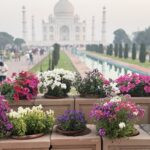
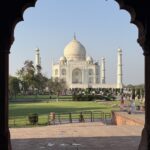
One of the selling points of Uniworld’s Golden Triangle Tour is that you get to see the Taj Mahal at sunset then again at sunrise, with one overnight stay. It was far less crowded at sunrise, though equally stunning at both times. Seeing the sun shining on the glistening white marble and the sky in hues of pink and blue made for great photos. It is massive. It is hard to imagine the scale of this monument until you stand before it. It really is a must-see, and if I had to choose, I’d see it at sunrise rather than sunset.
The hotel shuttled us to the entrance, but it is only about a 600 meter walk, and there is little traffic on this stretch of road.
There are “professional” photographers everywhere- find one and give him a few rupees. He will shoo the crowds away, pose you, and get the best possible shots. This was money well spent, and we got lots of great photos.
*Pro tip- wear something nice, brightly colored. Either bring a jewel-toned scarf or wear your vibrant hued tunic. If you dare, wear that sari- not I… it is too hot and uncomfortable for me. Wear makeup and fix your hair! These photos will be priceless, and with a little effort you can look like you really had a professional photo session!
Side note- I gained so much appreciation for Indian women on this trip! So many of them wear traditional dress. They look stunning when they go to market, wash clothes, even working the fields! Always beautifully dressed in all the colors of the rainbow!
The Taj Mahal was massive and pristine in its beauty. Few buildings in the world feel as ethereal as the Taj Mahal. Rising from the banks of the Yamuna River in perfect symmetry, the ivory-white glistening marble mausoleum seems to change with the light — glowing soft pink at sunrise and golden beneath the evening sun. Delicate floral inlays, intricately carved calligraphy, soaring minarets, and the immense central dome showcase the height of Mughal architecture, blending Persian, Islamic, and Indian artistic traditions into a monument that feels at once impossibly grand and remarkably graceful.
Reflecting pools make for great photo set up, if you can catch the reflection just right and catch a gap in the crowds…
You are allowed to go inside, but you must wear shoe covers and keep moving.
Inside the Taj Mahal, the atmosphere shifts from dazzling grandeur to quiet reverence. The central chamber contains the ornate marble cenotaphs of Mughal emperor Shah Jahan, who had the monument built, and Mumtaz Mahal, for whom the monument was built. These visible tombs are symbolic memorials, intricately decorated with pietra dura floral inlays and surrounded by delicate carved marble screens. The actual graves lie in a simpler crypt directly below, in keeping with Muslim burial traditions, and are closed to the public. Despite the crowds, the interior retains a hushed, echoing stillness that contrasts sharply with the brilliance of the exterior marble and gardens outside.
At the Taj Mahal, pietra dura is one of the monument’s most extraordinary details. Artisans set stones such as jade, lapis lazuli, carnelian, and jasper into the white marble walls to form delicate floral motifs that appear almost painted from a distance but are actually made from thousands of individually fitted stone fragments. The technique was introduced and refined under the Mughal emperors, blending Persian and Indian artistic traditions into the breathtaking craftsmanship seen throughout the mausoleum. Mesmerizing.
It is easy to see why the Taj Mahal is one of the New Seven Wonders of the World. Have you seen them all?
Chosen in a 2007 global poll, they include:
- Great Wall of China (China)
- Petra (Jordan)
- Colosseum (Italy)
- Chichen Itza (Mexico)
- Machu Picchu (Peru)
- Taj Mahal (India)
- Christ the Redeemer (Brazil)
I’ve seen them all except Petra!




India’s Golden Triangle: Jaipur
Known as the Pink City, Jaipur feels like stepping into a storybook of maharajas, desert fortresses, and vibrant color. Grand palaces and intricately carved temples rise from a maze of lively markets filled with textiles, gemstones, spices, and the constant hum of traffic and conversation. Yet beneath its royal façade, Jaipur is deeply rooted in daily life — a place where centuries-old traditions continue alongside modern Rajasthan. From sunrise over the hilltop forts to evenings lit by lanterns and the aroma of street food, Jaipur captures both the romance and energy that make India unforgettable.
The Oberoi Rajvilas
We were shuttled by motor coach the 6 hours to Jaipur, which was a nice, clean city with lots of shopping and dining options. The Oberoi Rajvilas was spectacular. They took the welcoming ceremony up a notch- as we entered, someone stood on a Juliet balcony above and sprinkled us with rose petals!
The main building which contained shops, restaurants, and the lobby, was lovely but again, the grounds stole the show. Set within 32 acres, there are reflecting ponds, manicured lawns, gardens, and individual villas and tents placed in little groupings with central courtyards and fountains. Golf carts are at your beck and call to transport you around, and the soundtrack is one of running water and peacock calls, which sound like mewling cats. Indias national bird adds bursts of color to the landscape of green and buildings of terra cotta, their jewel toned plumage catching the eye everywhere you look!
We had a little time to spend by the palatial pool, with its cushioned gazebos which looked ready to host harems of the Raj’s ladies. Again, I wish we had had an extra day to enjoy this lovely resort. If you have the option to have some downtime here, take it! Across from the pool was a lily pond surrounding a temple to Shiva, which was a tranquil oasis.
Our villa was spacious, with a kind sized bed, desk, and large bay windows with seats and shutters. The bathroom contained a large Italian marble soaking tub, which I actually made use of, with a massive window looking out into a small private courtyard. Apparently this was the entry-level room- there are private pool villas and luxury tents with private pools if you prefer. If you spend the money for one of those, be sure to build in time to enjoy it!
We dined at two of the onsite restaurants. This was not ideal for us, as we prefer to dine out in town, but the hotel was located about 30 minutes from town and we decided to stay onsite. With that said, the food was divine. We dined at both the Surya Mahal and the Raj Mahal. Highly recommend! We actually had a special event at the Raj Mahal where the men’s heads were wrapped in turbans and we enjoyed a dance and musical performance. It was a magical night, and we made a few new friends! We like to travel with open minds and hearts!
Jaipur—Rajasthan’s Princely City and Amber Fort
Jaipur is filled with monumental architecture that reflects its royal past, but three sites stand out for most visitors, and our tour focused on those: the Pink Palace, the observatory, and the hilltop fort at Amber. All day, I had the song “Pink Pony Club” in my head…
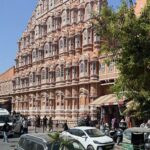
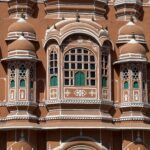
The “Pink Palace” is the iconic Hawa Mahal, a five-story façade of delicate pink sandstone carved with hundreds of latticed windows. Built for royal women of the court, it allowed them to observe street life and festivals unseen, while also funneling cool air through its honeycomb structure — both a visual symbol of Jaipur and an ingenious piece of climate design.


Nearby is the Jantar Mantar, an extraordinary 18th-century astronomical observatory built by Maharaja Jai Singh II. Rather than telescopes, it features massive stone and marble instruments designed to track celestial bodies with remarkable precision, blending science, architecture, and philosophy into a UNESCO World Heritage Site that still feels futuristic in its scale and ambition.
Rising outside the city is the majestic Amber Fort, a sprawling hilltop complex of palaces, courtyards, mirror halls, and ramparts overlooking Maota Lake. Built from pale sandstone and marble, it combines defensive strength with refined artistry — particularly in spaces like the Sheesh Mahal, where thousands of tiny mirrors scatter candlelight into a glittering illusion of stars. Together, these three sites capture Jaipur’s essence: royal spectacle, scientific curiosity, and fortress grandeur layered into one richly colored city.
-
- Pink Palace
-
- Window of Pink Palace
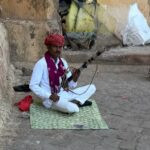
-
- Charmed Cobra

-
- Amber Fort
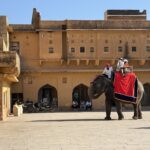
-
- Amber Fort
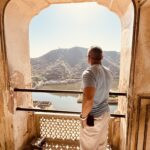
-
- Amber Fort
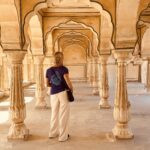
-
- Snake Charmer

I wish we had had more time to explore the city on our own… we really enjoy wandering together, seeing what we can and letting things happen on their own. But again… we will be back!
The next morning, we had a 4:00 am wake up for our early flight to Kolkata, where we’d embark upon the Ganges Explorer II for a week of unique and off-the-beaten path experiences! Stay tuned.



0 Comments