
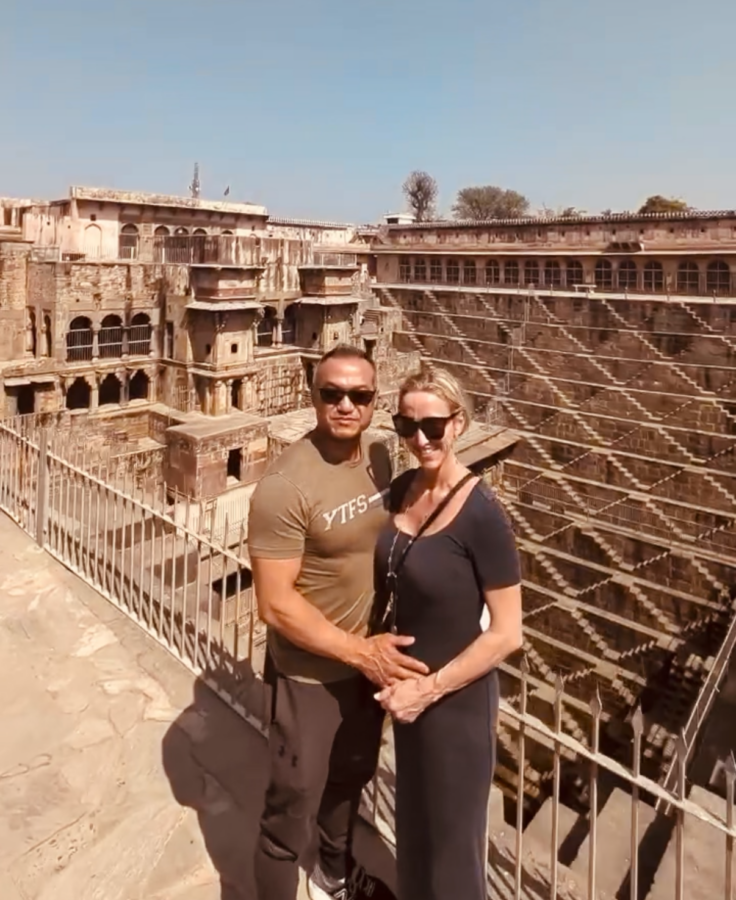
Chand Baori is one of the most extraordinary pieces of hydraulic architecture in India — and one of the most visually striking sites you can add to a Golden Triangle itinerary. It’s an ancient stepwell (called a baori or baoli), built both to collect water and to provide relief from Rajasthan’s brutal heat. Imagine an inverted pyramid descending deep into the earth in perfect geometric symmetry.
Chand Baori
We saw this otherworldly hidden wonder on Season 27 of The Amazing Race. The symmetry and scale were impressive, so when we started planning our trip to India, we wanted to include this spot.
Hidden in the small village of Abhaneri between Jaipur and Agra, Chand Baori is one of the most astonishing feats of ancient engineering in India. Constructed in the 8th or 9th century under the Gurjara-Pratihara dynasty, this massive stepwell descends roughly 100 feet (about 30 meters) into the earth across 13 levels connected by an estimated 3,500 perfectly symmetrical stone steps.
Designed to harvest and preserve water in Rajasthan’s harsh semi-arid climate, the square-shaped baori spans approximately 35 meters across and was engineered so villagers could access water no matter how dramatically levels rose and fell throughout the year. The temperature at the bottom can remain several degrees cooler than the desert surface above, effectively creating a naturally cooled refuge during scorching summers. Three sides of the structure are composed entirely of mesmerizing geometric stair patterns, while the fourth features ornate multi-story pavilions, balconies, and carved corridors once used as a summer getaway by royalty and priests.
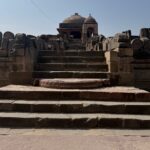
Adjacent to the well sits the ancient Harshat Mata Temple, tying the site’s hydraulic brilliance to its spiritual significance. Imagine if the excavated portion of the stepwell were taken out in one giant piece and plopped onto the ground next door… that is likely what the Harshat Mata Temple would have looked like before invaders destroyed it. Don’t miss taking a (counterclockwise) walk around this temple. It will add weight and historical perspective to your visit.
Even after more than a millennium, Chand Baori remains one of the deepest, largest, and most visually hypnotic stepwells ever built.
Getting There
Chand Baori did not really fit into our itinerary, but Tapas at Trinetra Tours made it work for us. Our flight arrived around 8:00 am, and one of Tapas’s handlers, Parveen, collected us at the airport, oriented us to the first portion of our tour, and handed us off to Mr. Ramesh. He was a fantastic driver- he was funny and engaging, sharing quips and stories but not talking our ears off.
Mr. Ramesh drove us the 4 hours from the Delhi airport to Abhaneri village in Rajasthan and back in one day. I watched India go by in a semi-stuporous haze of jet lag and wonder. The constant beeping of traffic in Delhi soon gave way to highways, which were basically giant swaths of pavement with cars headed in the same direction- there were lines to divide the lanes, but no one paid them attention! Mr. Ramesh told us you needed three things to successfully drive in India: a good horn, good brakes, and good luck! Thankfully, he had all three!
Interesting fact!
First, we passed through a suburb of Delhi, Gurugram. If you have ever called a help line and spoken to an Indian person with a thick accent, you have probably been in communication with someone here- this is the hub for call centers! Gurugram is known for its glass office towers, multinational corporations, tech campuses, and huge clusters of customer service and IT companies handling work for businesses around the world. It’s a sharp contrast to Old Delhi—modern, corporate, fast-growing, and filled with highways, malls, and luxury apartments.
For many young people in Gurugram, call center work became a gateway into India’s growing middle class during the country’s outsourcing boom. Employees—often recent college graduates from smaller cities and towns—worked overnight shifts to match American or European business hours, commuting through the neon-lit corporate districts while most of the city slept. Many adopted Westernized names and accents for customer calls, moving between two worlds each day: modern office towers filled with global companies and more traditional family lives at home.
The work could be repetitive and exhausting, but it also offered salaries, independence, and upward mobility that previous generations often never had access to, helping transform Gurugram from farmland into one of India’s most modern and globalized cities. So, the next time you feel frustrated about reaching one of these centers, give a thought to that young professional on the other end!
Soon, skyscrapers gave way to farmland. This portion of the drive introduced me to the colorful essence of India. We drove past verdant rice, wheat, and mustard fields speckled with vibrant flowering trees and shelters where workers could catch respite from the heat. The workers themselves wore all the colors of the rainbow, and multicolored flowers populated the median for most of the drive.
Our local guide met us at our vehicle and took us to the entrance. His name was Naresh and Tapas at Trinetra can request him for you!

Abhaneri Architectural Site
From the outside, Chand Baori gave little hint of what lay beyond its weathered walls. The entrance felt almost understated — quiet, sunbaked, and deceptively ordinary. But the moment we stepped through the narrow doorway, the earth seemed to suddenly fall away beneath us.
Before us opened a vast geometric canyon of perfectly symmetrical stone steps cascading deep into the ground, so intricate and immense that it was difficult to comprehend at first glance. The sight stopped us in our tracks. Layer upon layer of ancient stairways folded into one another like an optical illusion, drawing the eye downward into cool shadow and silence. It was one of those rare travel moments that genuinely steals your breath away — not because of grandeur alone, but because nothing prepares you for the scale, symmetry, and sheer artistry hidden just out of sight. Photos just don’t do it justice.
Our guide was a skilled photographer and videographer, and caught some of the coolest shots and angles for us. If you happen to visit and don’t have a guide pre-arranged, I recommend Naresh.
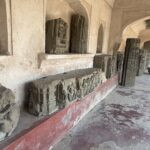
Beside the monumental Chand Baori sits the hauntingly beautiful ruins of the Harshat Mata Temple, a site that adds an entirely different layer of history and atmosphere to the experience. Dedicated to Harshat Mata — the goddess of joy, happiness, and abundance — the temple once stood as a richly adorned spiritual center for the region. Though much of it was destroyed centuries ago during invasions, scattered carvings and surviving stonework still hint at its former grandeur.
Intricately carved pillars, fragments of celestial dancers, floral motifs, and weathered deities lie throughout the complex like pieces of an ancient puzzle. In its prime, worshippers would descend into the cool waters of the stepwell to purify themselves before climbing back into the sunlight to offer prayers at the temple above. Today, the juxtaposition of the vast geometric precision of the baori beside the softened, timeworn beauty of the temple ruins creates an atmosphere that feels both sacred and cinematic — a reminder that this was never merely a water reservoir, but the vibrant heart of a once-thriving community.
-

- Stepwell
-
- Stepwell
-
- Stepwell
-
- Momma and Baby Camel Seen in Abhaneri

-
- Harshat Mata Temple
-
- Artifacts from Temple
Maybe you don’t want to spend 8+ hours in a vehicle to see this, but I am glad we did! It would be much easier to add this to your Golden Triangle tour:
Best Way to Include Chand Baori in your Golden Triangle tour
The smartest way is:
Jaipur → Chand Baori → Fatehpur Sikri → Agra
This turns a standard transfer day into one of the most memorable days of the trip.
Ideal Schedule
Morning
- Leave Jaipur around 8:00 AM
Late Morning
- Arrive Chand Baori
- Spend ~45–75 minutes
Lunch
- En route toward Fatehpur Sikri
Afternoon
- Visit Fatehpur Sikri
Evening
- Continue to Agra
This route is extremely common among higher-end private India tours because it breaks up the long Jaipur–Agra drive with something visually spectacular and much less touristy. Fatehpur Sikri is a remarkably preserved 16th-century Mughal city built by Emperor Akbar and briefly used as the capital of the Mughal Empire. Located about 40 km west of Agra, it is now a UNESCO World Heritage Site and one of the most architecturally fascinating stops in northern India. We missed it, but you don’t have to!
Side note: India is one of those places where you REALLY have to restrain your FOMO. Don’t try to pack too much into your trip or you risk truly absorbing the places you do see. Every road seems to lead to another fort, temple, or hidden wonder. But some of our favorite moments came when we stopped trying to check boxes and simply allowed ourselves to linger, wander, and fully experience where we were. We packed a lot into our trip, which ended up spanning a month. Read about the basics of our trip here.
By the time we climbed back out of the geometric depths of Chand Baori, it already felt like India had pulled us into another century. And somehow, this was only the beginning—the ancient stepwell would soon give way to winding jungle roads, distant alarm calls, and our first glimpse into the wild heart of Bandhavgarh National Park.



0 Comments